
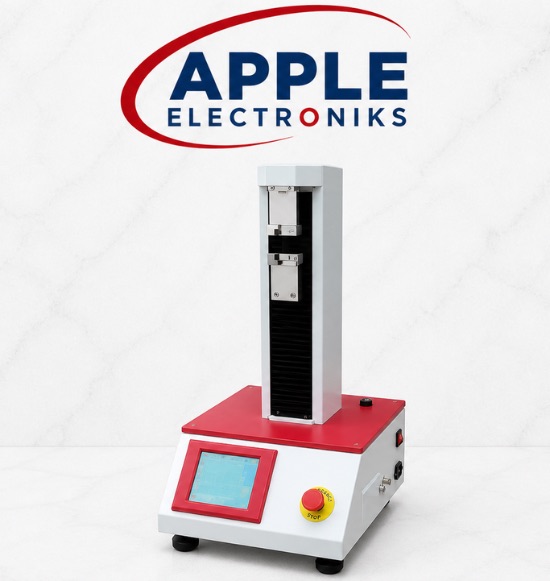
FTT Fiber Tenacity & Elongation Tester
The FTT Fiber Tenacity & Elongation Tester is designed for measuring the breaking strength and elongation — commonly referred to as tenacity and elongation — of single textile fibres and fine filaments. It accommodates a broad range of materials including chemical fibres, polypropylene fibres, polyester spun fibre, cotton, wool, ramie, silk, glass fibre, and fine metallic thread. Results are displayed in real time on a large touch screen panel, giving operators immediate visibility of force and elongation values throughout each test cycle.
Built on a 32-bit MCU with a 16-bit AD converter and driven by a precision servo motor and ball-screw mechanism, the FTT delivers load measurement accuracy of 0.02% (F.S) and elongation accuracy of 0.01mm. Test speed is continuously adjustable from 1 to 200mm/min, and the gauge length can be set up to 200mm to accommodate fibre specimens of varying length. The two-set grip system allows quick loading and unloading, reducing changeover time between specimens.
Breaking force or tenacity can be expressed in cN, N, Kgf, or lb; maximum, minimum, and average values are automatically calculated across each testing batch, eliminating manual data reduction. The FTT complies with ISO 5079, ISO 11566, ASTM D 3822, BS 4079, IS 17266, and IS 235, making it suitable for fibre producers, spinning mills, quality control laboratories, and research institutions requiring traceable single-fibre strength data.
Specifications
Maximum Load Test
500cN / 1000cN
Load Measuring Accuracy
0.02% (F.S)
Resolution
0.01 cN
Data Frequency
≥ 1000Hz
Elongation Measuring Accuracy
0.01mm
Zero Drift
≤ 0.2% (F.S)
Test Speed
1 ~ 200mm/min (adjustable)
Gauge Length
≤ 200mm
Minimum Clamping Distance
0.1mm
Power Supply
220V, 50Hz
Weight
55 kg
Dimensions
400 × 450 × 600 mm (L × W × H)
Key Features
Large touch screen panel with real-time display of testing results and instrument settings — operators can monitor force and elongation values continuously throughout each test
32-bit MCU with 16-bit AD converter and precision servo motor + ball-screw drive — provides high measurement repeatability and fast sensor response for single-fibre testing
Breaking force or tenacity measurable in cN, N, Kgf, or lb; maximum, minimum, and average values are automatically calculated for every testing batch — no manual data reduction required
High accuracy and fast sensor response ensure reliable results even for delicate or low-denier fibres where force variations occur rapidly
Digital technology for calibrations and force measurement — no manual mechanical adjustments; calibration is performed and verified through the touch screen interface
Two-set grip system enables fast and easy specimen loading and unloading, minimising changeover time between consecutive single-fibre tests
Test Standards
ISO 5079
ISO 11566
ASTM D 3822
BS 4079
IS 17266
IS 235
Key Highlights
500cN / 1000cN Dual-Range Capacity with 0.01 cN Resolution
The FTT is available in two load-cell capacities — 500cN and 1000cN — to cover the full range of single-fibre and fine-filament strengths encountered in production and research. With a resolution of 0.01 cN and a load measuring accuracy of 0.02% (F.S), the instrument captures even the finest force variations reliably, ensuring that breaking force and tenacity values are both accurate and repeatable across all tested fibre types.
1~200mm/min Continuously Adjustable Test Speed
Test speed can be set anywhere between 1mm/min and 200mm/min to match the requirements of different fibre types and test standards. The precision servo motor and ball-screw drive maintain the programmed speed without deviation throughout the test stroke, ensuring that the strain rate remains constant — a critical requirement for accurate tenacity and elongation-at-break measurement under ISO 5079, ASTM D 3822, and related methods.
32-bit MCU & 16-bit AD with Touch Screen — Auto Max/Min/Average
The 32-bit MCU paired with a 16-bit AD converter samples force data at ≥1000Hz, capturing the complete load-elongation curve for every specimen. The large touch screen panel displays real-time force and elongation values and automatically calculates maximum, minimum, and average results across the batch — providing the statistical summary required by fibre quality control procedures without any post-test manual calculation.
The FTT is designed for single-fibre and fine-filament testing across a wide range of materials. It can test natural fibres such as cotton, wool, ramie, and silk; synthetic and man-made fibres including polypropylene, polyester spun fibre, and chemical fibres; and specialty materials such as glass fibre and fine metallic thread. Any material that can be presented as a single filament or fine strand within the 500cN or 1000cN load range and up to 200mm gauge length is compatible with the instrument.
Tenacity is the breaking force of a fibre expressed per unit linear density (typically cN/dtex or cN/tex). It allows meaningful comparisons of fibre strength independent of the fibre's fineness. The FTT measures breaking force directly in cN, N, Kgf, or lb as the crosshead stretches the clamped single fibre at a constant rate until it breaks. The instrument records the peak force (breaking force) and the crosshead displacement at break (elongation). Tenacity is then calculated by dividing breaking force by the fibre's linear density, which can be entered by the operator or obtained from a separate linear density test.
The FTT is available in two load-cell configurations: 500cN and 1000cN. The 500cN model is suited for delicate fibres such as fine silk, ultra-fine polypropylene, and low-denier synthetics, where high measurement resolution is critical. The 1000cN model handles heavier fibres such as coarse wool, glass fibre, and metallic thread where higher breaking forces are expected. Both models share the same 0.01 cN resolution and 0.02% (F.S) accuracy specification. Please specify the required capacity when ordering.
The FTT can display breaking force in cN (centinewtons), N (newtons), Kgf (kilogram-force), or lb (pound-force), selectable from the touch screen. This flexibility allows the instrument to be used directly with any international standard without requiring manual unit conversion: ISO and BS standards typically express results in cN or mN/tex, while older or non-metric standards may use gf or lb. Maximum, minimum, and average breaking force values are automatically computed and displayed after each batch of tests.
The FTT complies with ISO 5079 (Textile fibres — determination of breaking force and elongation at break of individual fibres), ISO 11566 (Carbon fibre — determination of the tensile properties of single filament specimens), ASTM D 3822 (Standard test method for tensile properties of single textile fibres), BS 4079, IS 17266, and IS 235. These standards collectively cover natural fibres, synthetic fibres, carbon fibres, and specialty filaments, ensuring the instrument is accepted for quality control and certification testing across Indian and international supply chains.
The FTT is supplied with two sets of fibre-holding grips. While one fibre specimen is being tested in the instrument, the operator can prepare and mount the next specimen in the spare set of grips. Once the test is complete and the result is recorded, the grips are exchanged rapidly — minimising the dead time between consecutive tests. This design is particularly valuable when testing large batches of single fibres, as required by ISO 5079, which specifies a minimum of 20 replicate measurements per sample for reliable statistical results.
Test speed is adjustable from 1mm/min to 200mm/min. The correct speed for each test is specified by the applicable standard and fibre type: ISO 5079 specifies a rate of extension such that the time to break is 20 ± 3 seconds, while ASTM D 3822 specifies a crosshead speed of 12mm/min for the standard 20mm gauge length. Incorrect speed introduces a systematic error into breaking force and elongation results. The FTT's wide speed range ensures full compliance with all major methods, and the servo drive maintains the set speed precisely without hunting or overshoot.
The FTT requires a standard 220V, 50Hz single-phase power supply. It weighs 55 kg and has a compact bench-top footprint of 400 × 450 × 600mm (L×W×H), making it suitable for placement on a standard laboratory bench without structural modification. No special environmental conditioning is required beyond the standard laboratory atmosphere specified by the test method (typically 20°C ± 2°C and 65% ± 4% RH per ISO 139). The instrument is supplied by Apple Electroniks, Vadodara, with installation guidance and after-sales support.
WHAT OUR CLIENTS SAY
Trusted by industries worldwide for precision testing equipment and reliable solutions.
Send Your Requirement
Looking for laboratory testing equipment, material testing machines, or customized automation systems? Share your requirement and our team will get back to you with the right solution.
WATCH APPLE ELECTRONIKS
Explore our precision testing machines, industrial solutions, and engineering capabilities through our company video.
- Precision-engineered testing machines
- Wide range of industrial testing solutions
- Customized systems based on requirements
- Serving textile, polymer, and electrical industries
- Focus on quality, accuracy, and reliability


