
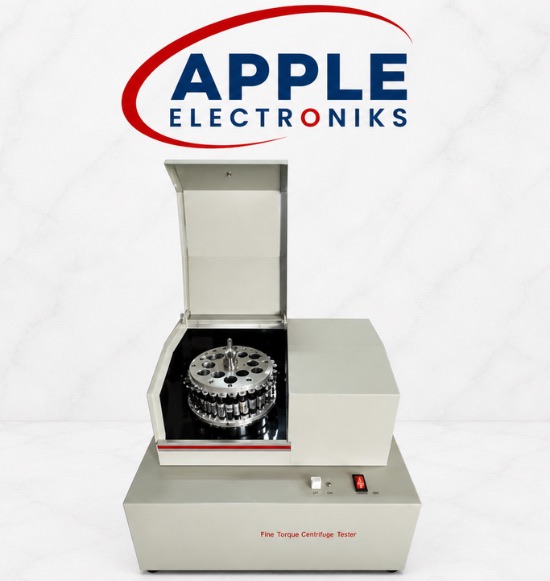
TST Fiber Thermal Shrinkage Tester
The TST Fiber Thermal Shrinkage Tester is designed to measure the dry-heat thermal shrinkage of synthetic staple fibres, including polyester, nylon, and polypropylene. A built-in industrial video camera measures the length of each fibre mounted on the sample cylinder both before and after thermal treatment, and the software automatically calculates the average thermal shrinkage rate and coefficient of variation (CV) for the tested batch. The testing process is fully computer-controlled, with all data captured, processed, and displayed without manual intervention.
The instrument is built around high-precision components — including a precision ball screw, precision sensor, a multi-directional mechanical arm, and a built-in precision oven — to deliver measurement accuracy of ±0.01mm on sample length and a thermal shrinkage error of no more than ±0.1%. The oven operates over a settable range from ambient temperature up to 250°C, maintaining the set point to within ±0.1°C throughout each heating cycle. Tension clamps apply a pre-tension of 0.5cN per fibre piece, and the clamp configuration can be customised to provide alternative pre-tension values where the test method requires.
Two sample cylinders are supplied, each accommodating up to 36 fibre specimens, and the software supports cross-testing across both cylinders simultaneously — substantially reducing total testing time for high-throughput fibre quality laboratories. A revolving sample plate makes specimen loading and unloading straightforward, and once testing is complete the report can be printed directly or exported to Excel format for record-keeping, process traceability, and further statistical analysis.
Specifications
Measuring Range – Thermal Shrinkage
0 ~ 45%
Measuring Error – Thermal Shrinkage
≤ ±0.1%
Measuring Accuracy – Sample Length
±0.01mm
Gauge – Upper to Lower Clamps
20mm ± 1mm
Fibre Number per Sample Cylinder
Up to 36
Tension Clamp
0.5cN/pc
Oven Temperature Range
RT ~ 250°C (settable)
Oven Temperature Accuracy
±0.1°C
Compressed Air
(0.4 ~ 0.8) MPa
Power Supply
220V / 110V, 50/60 Hz
Gross Weight
70kg / 140kg
Key Features
Built-in industrial video camera measures each fibre length on the sample cylinder automatically before and after thermal treatment — eliminates manual measurement errors and delivers consistent, operator-independent results
Revolving sample plate with two sample cylinders, each holding up to 36 fibres — the software supports simultaneous cross-testing across both cylinders, greatly improving throughput for high-volume fibre quality control laboratories
Built-in precision oven with RT ~ 250°C settable temperature range and ±0.1°C accuracy — ensures thermal treatment conditions are precisely controlled and repeatable from one test cycle to the next
Precision mechanical arm with multi-directional movement (up, down, left, right) combined with a precision ball screw and sensor — provides reliable, repeatable fibre measurement and handling with no manual positional adjustment
Automatic calculation of average thermal shrinkage rate and CV — delivers full statistical output for each test batch without manual data reduction, meeting the reporting requirements of standard test methods
Test results can be printed directly from the software or exported to Excel — facilitates QC documentation, process traceability, and integration with laboratory information management systems
Test Standards
GB/T 6505
ASTM D 4974
Key Highlights
Camera-Based Auto Length Measurement at ±0.01mm Accuracy
The TST replaces manual fibre length measurement with a built-in industrial video camera that scans each specimen on the sample cylinder before and after heating. Length measurements are captured at ±0.01mm accuracy, and the software automatically computes the shrinkage value for each fibre — eliminating the measurement variability that arises from hand-measurement methods and delivering results that are fully traceable and reproducible across operators and shifts.
Built-in Precision Oven: RT ~ 250°C at ±0.1°C Temperature Accuracy
The integrated oven heats the sample cylinder to any user-programmed temperature between ambient and 250°C, maintaining the set point to within ±0.1°C throughout the treatment period. Tight temperature control is critical for thermal shrinkage testing because fibre shrinkage is highly sensitive to treatment temperature — even a 1–2°C deviation can produce measurable differences in the result, particularly for fibres tested near their crystallisation or glass-transition temperatures.
Dual-Cylinder Cross-Testing for High-Throughput Fibre Laboratories
Two sample cylinders are included with the TST, each capable of holding up to 36 individual fibre specimens. The software supports simultaneous cross-testing across both cylinders — while one cylinder is being thermally treated in the oven, the other can be measured or re-loaded, ensuring the instrument is rarely idle. This workflow is especially valuable in production quality control environments where large numbers of fibre lots must be screened against shrinkage specifications within a single shift.
The TST is designed specifically for synthetic staple fibres that exhibit measurable thermal shrinkage under dry-heat conditions. The primary fibre types are polyester staple fibre, nylon (polyamide) fibre, and ylene fibre. The instrument can accommodate any staple fibre that can be mounted as individual specimens on the sample cylinder within the 20mm gauge length, and for which the expected shrinkage falls within the 0 to 45% measuring range. Natural fibres with negligible dry-heat shrinkage are generally outside the intended scope of this instrument.
Fibres are mounted on the sample cylinder under a pre-tension of 0.5cN per piece, applied by the tension clamp. The built-in industrial video camera, mounted on a multi-directional mechanical arm, scans each fibre position on the cylinder and measures the initial length of every specimen to ±0.01mm accuracy. After the thermal treatment cycle in the built-in oven is complete, the camera re-measures each fibre at the same positions. The software computes the length change for each specimen and calculates the shrinkage percentage, average shrinkage, and CV across the full batch automatically — with no manual measurement required at any stage.
The built-in precision oven has a settable temperature range from room temperature (RT) up to 250°C, covering the full range of dry-heat conditions specified by standard shrinkage test methods for polyester, nylon, and polypropylene fibres. The oven maintains the programmed temperature to within ±0.1°C throughout the treatment period. This level of accuracy is important because fibre shrinkage is highly sensitive to temperature: a deviation of even 1–2°C from the specified treatment temperature can introduce measurable bias into the shrinkage result, particularly for fibres tested close to characteristic transition temperatures.
Each sample cylinder can hold up to 36 individual fibre specimens simultaneously. Since two cylinders are supplied with the TST, the instrument can process up to 72 fibre measurements per test session when both cylinders are used in cross-testing mode. The high specimen count per cylinder is important for obtaining statistically meaningful shrinkage data: standard test methods typically require a minimum of 20 to 30 replicate specimens to characterise the average shrinkage and CV of a fibre lot reliably, and loading 36 specimens per cylinder ensures this requirement is met in a single run.
After measuring all fibres on the cylinder before and after thermal treatment, the TST software automatically calculates the individual shrinkage percentage for each fibre specimen, the average thermal shrinkage across the full batch, and the coefficient of variation (CV) of the batch. The CV is a key quality parameter in fibre production: a high CV indicates that some fibres shrink significantly more or less than the mean, pointing to process inconsistencies. No manual calculation or post-test data entry is required — all values are displayed on-screen and included in the printable or exportable test report.
The TST is supplied with two sample cylinders mounted on a revolving plate. While one cylinder is inside the oven undergoing the thermal treatment cycle, the operator can load a fresh set of fibre specimens onto the second cylinder on the outside position. Once treatment is complete and the camera has completed its post-heat measurement scan, the revolving plate positions the pre-loaded cylinder for its initial measurement, and the cycle restarts without the instrument sitting idle between batches. The software tracks both cylinders independently and associates the correct pre- and post-treatment length data for each.
The TST operates on 220V or 110V at 50/60Hz — the appropriate voltage variant should be specified at the time of order to match the local supply. In addition to electrical power, the instrument requires a compressed air supply in the range of 0.4 to 0.8 MPa to operate the pneumatic components of the mechanical arm and tension clamp system. The instrument is available in two weight configurations — 70kg and 140kg gross weight — reflecting different model configurations. Installation should be planned to accommodate the compressed air connection and provide adequate bench or floor space for the chosen configuration.
Yes. The TST software supports two reporting outputs: the test report can be printed directly from the connected computer, providing a hard-copy record suitable for QC files and shipment documentation; or it can be exported to Excel format, which allows the raw data, individual shrinkage values, average, and CV to be saved to a spreadsheet for further analysis, trending, or integration into a laboratory information management system. The straightforward software interface is designed to minimise the learning curve for laboratory operators, and the export function requires no additional software beyond standard Microsoft Excel.
WHAT OUR CLIENTS SAY
Trusted by industries worldwide for precision testing equipment and reliable solutions.
Send Your Requirement
Looking for laboratory testing equipment, material testing machines, or customized automation systems? Share your requirement and our team will get back to you with the right solution.
WATCH APPLE ELECTRONIKS
Explore our precision testing machines, industrial solutions, and engineering capabilities through our company video.
- Precision-engineered testing machines
- Wide range of industrial testing solutions
- Customized systems based on requirements
- Serving textile, polymer, and electrical industries
- Focus on quality, accuracy, and reliability


