
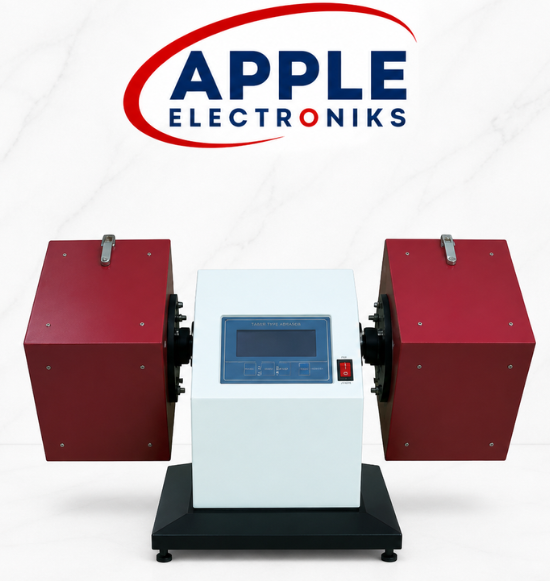
ICI Pilling Tester – Latest Model
The ICI Pilling Tester is the recognised instrument for rapidly replicating pilling and snagging on fabrics in a fraction of the time taken by normal wear, making it the standard tool for predicting in-service pilling behaviour of textile materials. The test method subjects fabric specimens mounted inside lined boxes or drums to a tumbling action, mimicking the repeated mechanical agitation that causes fibres to tangle and form pills on the surface of the fabric. The resulting appearance is rated against photographic standards to assign a pilling grade.
The instrument is built around a universal drive system that accepts both ICI Pilling boxes and drums as well as Snagging boxes and drums — enabling both test types on a single machine without a separate drive unit. An electronic digital counter provides accurate test cycle control, and a purpose-designed sample mounting fixture ensures consistent specimen presentation. The instrument is available in two configurations: ICI\2 with two test stations and ICI\4 with four test stations, allowing the laboratory to select the model that best matches its testing throughput requirements.
The ICI Pilling Tester operates at 60 ± 2 rpm and is controlled by a single chip controller, with a compact bench-top footprint of 800 × 500 × 600 mm. It complies with all major pilling and snagging test standards including IS 10971, ISO 12945-1, BS 5811, BS 8479, JIS 1058, JIS L1076, NEXT 19, IWSTM152, and M&S buyer standards P18, P19, and P21A — making it suitable for testing against most international apparel, hosiery, and retailer specification requirements.
Specifications
Rotation Speed
60 ± 2 rpm
Control Mode
Single Chip Control
Power
220 / 110 V, 50/60 Hz, 4A
Weight
55 kg (2 station)
Dimensions (L × W × H)
800 × 500 × 600 mm
Models Available
ICI\2 — 2 Station | ICI\4 — 4 Station
Optional Accessories
Pilliscope Assessment Viewer | Mounting Zig
Key Features
Universal drive system accepts both ICI Pilling boxes and drums and Snagging boxes and drums — enabling both pilling and snagging test types on a single instrument without requiring a separate drive unit for each test method
Electronic digital counter provides precise test cycle control — ensuring the specimen tumbling count is accurately recorded and the test can be stopped at the exact pre-set number of cycles specified by the relevant standard
Purpose-designed sample mounting fixture ensures consistent and secure specimen presentation for every test — reducing variability from specimen loading and contributing to repeatable, reproducible pilling assessments
Available in 2-station (ICI\2) and 4-station (ICI\4) configurations — allowing the laboratory to select the model that best matches its testing throughput requirements and available bench space
Test Standards
IS 10971
ISO 12945-1
BS 5811
BS 8479
JIS 1058
JIS L1076
NEXT 19
IWSTM152
M&S P18
M&S P19
M&S P21A
Key Highlights
Universal Drive — Pilling & Snagging on One Instrument
The ICI Pilling Tester's universal drive system is designed to accept both ICI Pilling boxes and drums and Snagging boxes and drums interchangeably. This means a single instrument can perform both pilling assessments (where fibres tangle to form surface pills during tumbling) and snagging tests (where protruding yarns or loops are pulled out during contact with rough surfaces) — removing the need for a separate snagging drive unit. The instrument is supplied as a complete, ready-to-test system with the sample mounting fixture included.
Electronic Digital Counter with Single Chip Control
The electronic digital counter ensures that the exact number of tumbling cycles specified by the test standard is applied to every specimen — eliminating the imprecision of manual timing or mechanical counters. The single chip controller provides reliable operation and consistent drive speed at 60 ± 2 rpm throughout the test duration. Accurate cycle counting is critical in pilling tests because the pilling grade is highly sensitive to over- or under-testing, and both ISO 12945-1 and BS 5811 specify precise cycle counts at which the specimen must be assessed and rated.
2-Station and 4-Station Models for Scalable Throughput
The ICI Pilling Tester is available in two station configurations: the ICI\2 with two test positions and the ICI\4 with four test positions. Both models share the same universal drive system and electronic counter. Laboratories with lower test volumes or limited bench space can select the ICI\2, while higher-throughput testing environments — such as commercial testing laboratories, fabric mills, or apparel retailers conducting buyer specification tests — can select the ICI\4 to test four specimens simultaneously. Both models comply with the same list of international and retailer standards.
The ICI Pilling Tester is designed primarily for woven and knitted fabrics used in apparel, hosiery, and upholstery — including wool, wool-blend, synthetic, and blended fibre fabrics. It is particularly suitable for fabrics prone to pilling or snagging during normal wear, such as knitwear, jerseys, fleece fabrics, and loosely-woven or brushed surfaces. The instrument is also used for testing fabrics to retailer specifications such as M&S P18, P19, and P21A, which mandate pilling performance requirements for garments supplied to those buyers. The test method covers a wide range of fabric constructions without restriction on fibre type.
Pilling testing replicates the process by which fibres migrate to the surface of a fabric during repeated mechanical agitation, tangle together, and form small fibre balls (pills). The test specimen is mounted inside a lined box and tumbled at a controlled speed for a set number of cycles; the resulting surface appearance is then rated on a 1–5 scale against photographic standards, where 5 is no pilling and 1 is very heavy pilling. Snagging testing assesses whether the fabric's yarns or loops are vulnerable to being caught and pulled out by rough or abrasive surfaces during wear. The ICI instrument uses separate snagging boxes and drums (different lining material and box geometry) on the same universal drive system to replicate this distinct failure mode.
The ICI Pilling Tester operates at a rotation speed of 60 ± 2 rpm, which is the speed specified by ISO 12945-1, BS 5811, and the other major pilling and snagging test standards to which the instrument complies. This speed is maintained by a single chip controller that regulates the drive motor to keep the drum rotation consistent throughout the test. The ± 2 rpm tolerance is within the limits specified by the standards. Consistent rotation speed is important because the energy imparted to the specimen per cycle directly influences the rate and extent of pilling — deviations from the specified speed would affect the comparability of results between laboratories and between test runs on the same instrument.
The ICI\2 is a 2-station model that tests two specimens simultaneously, making it appropriate for laboratories with moderate testing volumes or limited bench space. The ICI\4 is a 4-station model that tests four specimens simultaneously — doubling throughput compared to the ICI\2 and making it the better choice for commercial testing laboratories, large fabric mills, or apparel buyers that need to test multiple fabric lots or multiple replicates per lot in a single test run. Both models have the same drive speed, counter, and standards compliance. The published weight specification of 55 kg refers to the 2-station model; the 4-station model is heavier. Both share the same 800 × 500 × 600 mm footprint for the drive unit.
The ICI Pilling Tester complies with the following standards: IS 10971 (Indian standard for pilling resistance of knitted fabrics); ISO 12945-1 (pilling by the ICI pilling box method); BS 5811 (pilling resistance of woven fabrics); BS 8479 (snagging resistance); JIS 1058 and JIS L1076 (Japanese pilling standards); NEXT 19 (retailer specification); IWSTM152 (International Wool Secretariat test method for pilling); and M&S buyer standards P18, P19, and P21A (Marks & Spencer pilling and snagging specifications for apparel). This broad standards coverage supports testing for domestic and export markets including India, the UK, Europe, and Japan, as well as compliance with major retailer specification requirements.
The Pilliscope Assessment Viewer is an optional accessory used for visual pilling grade assessment after testing. It provides a controlled, standardised viewing environment — typically with a defined light source, viewing angle, and background — to minimise subjectivity in the pilling grade assessment process. Pilling grading is inherently a visual judgement comparing the tested specimen against photographic reference standards on a 1–5 scale; inconsistent lighting or viewing conditions introduce inter-operator variability. The Pilliscope is particularly useful for laboratories that need to achieve consistent grades between operators or between laboratory locations, and is recommended for commercial testing environments where results are reported to customers or used in buyer approval processes.
The Mounting Zig (jig) is an optional accessory that assists with the precise and consistent mounting of fabric specimens onto the test tubes or holders used in the ICI pilling and snagging test methods. Correct specimen mounting — with uniform tension, accurate positioning, and no creases or distortions — is important for reproducible results because specimen presentation affects how the fabric interacts with the lining material inside the pilling box during the test. The Mounting Zig ensures that each operator applies the specimen in the same manner, reducing the operator-to-operator variability that can otherwise affect pilling grade outcomes — particularly relevant in multi-operator or multi-shift laboratory environments.
The ICI Pilling Tester operates on 220V or 110V at 50/60 Hz with a current draw of 4A, making it compatible with both Indian standard mains supply and international installations. The 2-station model weighs 55 kg and has bench-top dimensions of 800 × 500 × 600 mm (L × W × H), suitable for a standard laboratory bench. No compressed air, special utilities, or dedicated floor installation is required. The instrument should be placed on a stable, level surface — excessive vibration can affect the uniformity of drum rotation and introduce variability into the test. The bench surface should be capable of supporting the instrument weight with an adequate safety margin.
WHAT OUR CLIENTS SAY
Trusted by industries worldwide for precision testing equipment and reliable solutions.
Send Your Requirement
Looking for laboratory testing equipment, material testing machines, or customized automation systems? Share your requirement and our team will get back to you with the right solution.
WATCH APPLE ELECTRONIKS
Explore our precision testing machines, industrial solutions, and engineering capabilities through our company video.
- Precision-engineered testing machines
- Wide range of industrial testing solutions
- Customized systems based on requirements
- Serving textile, polymer, and electrical industries
- Focus on quality, accuracy, and reliability


